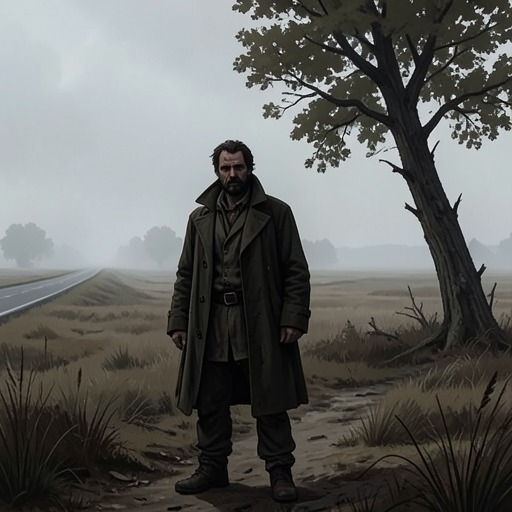
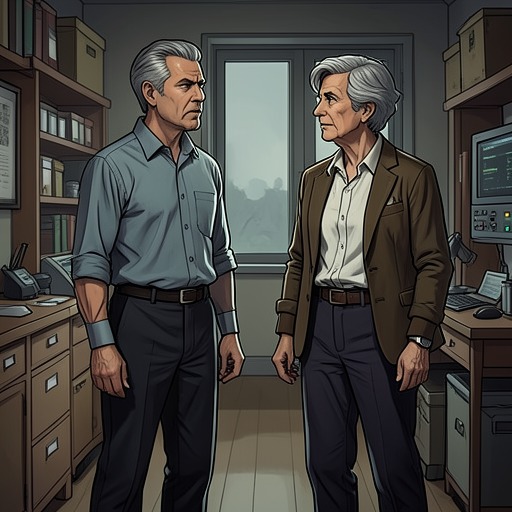
The newspaper photograph of Thomas Singleton and Michael Downey
Down Cemetery RoadThe newspaper photograph of Thomas Singleton and Michael Downey is a small but consequential piece of evidence: an old newspaper image that connects a reported helicopter crash to the men whose apparent deaths Sarah Trafford has reason to doubt. Joe produces it as a likeness of Thomas Singleton, but the photograph becomes more than a record of the past when Sarah recognizes the second man as Michael Downey, the person who had been waiting for her in a car park. The image does not explain what happened to either man. Instead, it makes the official-looking story newly uncertain.
Identity and Physical Description
Joe says that he took the image from an old newspaper, from a story about the helicopter crash. Sarah unfolds a picture of two men in uniform, relaxed and smiling, apparently about her age or perhaps a little older. These are specific, unceremonious details: the men are not shown in combat or presented as distant public figures. They appear together in a moment of ease, and the photograph preserves that moment without supplying any account of what followed.
The image distinguishes the men through small gestures. The one on the left is squinting in the sun. Thomas Singleton, identified by Joe, holds a cupped cigarette at chest level. The photograph gives Sarah and Joe visible features to examine, but the evidence described in the scene remains limited: the cigarette, the squint, the uniforms, and the smiles. It shows the men together; it cannot by itself establish their later fates.
How the Photograph Enters the Search
Joe brings out the picture while explaining that he will help Sarah, provided the matter does not involve policemen, spies, or soldiers. His offer is personal, and he admits that he also expects the danger not to materialize. The photograph follows this exchange as a practical contribution to her search for Dinah Singleton: Joe says it may not interest Sarah, yet gives her the likeness of Thomas, taken from the old report. The object therefore arrives within a conversation about the limits of Joe’s willingness, while immediately extending the inquiry beyond Dinah’s disappearance.
Joe identifies Thomas’s companion as a friend who was in the helicopter with him. When Sarah asks the companion’s name, Joe can only supply it uncertainly: Michael Downey, he thinks. He then considers that Michael may still be alive too. His hesitation matters. The photograph gives the name a face, but Joe does not present himself as certain about the man’s identity or fate. The newspaper account and the surviving image provide a starting point, not a resolution.
Recognition and Reversal
Sarah answers Joe’s suggestion with confidence. She says she would bet that Michael Downey is still alive, and, when Joe asks why, explains that he is the man who was waiting for her in the car park. The photograph’s second figure is thus connected to a present encounter that Joe could not have inferred from the clipping alone. Sarah’s recognition changes the image from an old illustration of a reported crash into a clue about someone she has personally seen.
The exchange turns on a contrast in knowledge. Joe handles the photograph and knows its newspaper context; Sarah supplies the decisive identification from her own experience. Neither the image nor Joe’s recollection settles every question, but Sarah’s statement makes the printed story inadequate as a complete account. The photo’s force comes from that mismatch: the man associated with the crash is not merely a name attached to an old report, because Sarah links him to the car park in which she encountered him.
Narrative Function
The photograph joins two strands of the mystery without explaining away their uncertainty. Thomas Singleton appears in the newspaper story about the helicopter crash, while Michael Downey is first introduced to Sarah through the car-park encounter and then recognized in the image. Its documentary origin gives the conversation a material anchor, yet its contents remain only a likeness of two men at an earlier moment. It confirms that the men were together and gives Sarah a face to connect with her memory; it does not establish what became of them afterward.
That distinction makes the object useful to the novel’s unfolding investigation. The image is evidence, but not proof of the story printed around it. Joe’s identification is qualified, and Sarah’s recognition supplies a separate, immediate basis for doubting that Michael is dead. The scene leaves the photograph’s most important implication unresolved: whether the reported crash and the men’s presumed fates can be trusted. Rather than closing the past into a settled newspaper account, the old picture opens it back up to scrutiny.